Scroll with Seven Seals
Book of RevelationThe Scroll with Seven Seals is the closed document at the center of Revelation 5’s heavenly scene: held by the one seated on the throne, it cannot be opened by any creature until Jesus Christ takes it as the slain Lamb. In the book’s interpretation, its transfer marks the threshold to the events revealed by the seals and anchors a proposed chronological reading of Revelation.
Appearance and Position
The scroll lies in the right hand of the one seated on the throne. It is written on both the inside and the back, and seven seals secure it. The account presents it as a complete, sealed document, but does not explain its contents in this scene. Its position in the throne room gives the question of access immediate importance: the scroll is present, yet its message remains inaccessible until someone proves worthy to open it.
Worthiness and Transfer
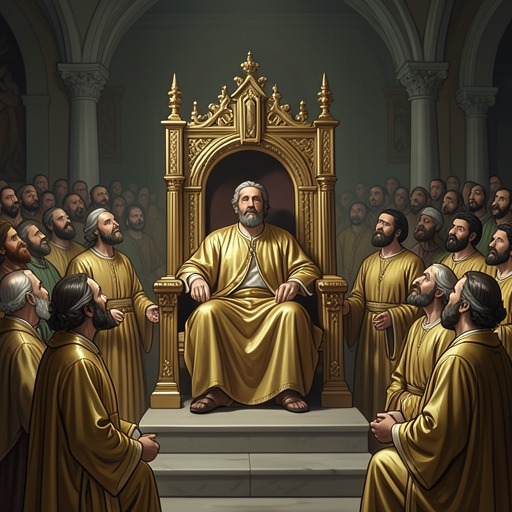
A strong angel publicly asks who is worthy to open the scroll and release its seals. No one in heaven, on earth, or beneath the earth can open it or even look upon it. John the Apostle weeps because no worthy opener has been found. One of the Twenty-Four Elders tells him not to weep, identifying the victor as the Lion of the tribe of Judah and the Root of David. When John looks, he sees a Lamb that appears as though it had been slain, standing amid the throne, the Four Living Creatures around the Throne, and the elders. The Lamb approaches and takes the scroll from the right hand of the enthroned figure; the narrative thus makes worthiness, rather than possession alone, the condition for its opening.
The Heavenly Response
The taking of the scroll changes the scene from suspended expectation to collective worship. The Four Living Creatures around the Throne and the Twenty-Four Elders fall before the Lamb. The elders carry harps and golden bowls associated with the prayers of the saints, linking the scroll’s transfer to the devotional life of those represented in the vision. They sing a new song that declares the Lamb worthy because he was slain and redeemed people for God from every tribe, language, people, and nation. The song also connects the act of opening the seals with a promised future: those redeemed are made a kingdom and priests and are to reign on earth.
Role in the Book’s Chronology
The author argues that Revelation is not entirely arranged in chronological order and that recognizing its reordered passages can resolve interpretive disagreements. Within his reconstruction, Revelation 5 describes the first event in the prophetic sequence: a celebration around the throne takes place as the seals are about to be opened. He also reads the absence of saints in white robes in this scene as an indication that the rapture has not yet occurred. The scroll therefore serves both as the object that initiates the seal sequence and as a structural hinge in the author’s chronology, joining the heavenly declaration of the Lamb’s worthiness to the events that follow.